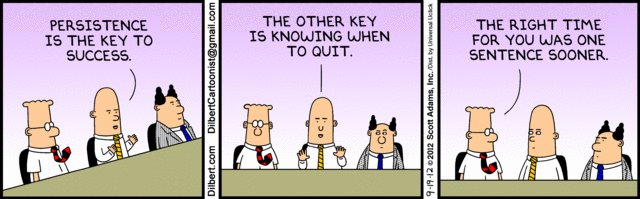
What does nearly every genius have in common when it comes to work habits?

genius
A very interesting new book, Daily Rituals: How Artists Work, examines the work habits of over 150 of the greatest writers, artists and scientists.

What does nearly every genius have in common?

Those interested in the 10,000 hour theory of deliberate practice won’t be surprised — the vast majority of them were complete and unapologetic workaholics.

Via Daily Rituals: How Artists Work:

William Faulkner:

During his most fertile years, from the late 1920s through the early ’40s, Faulkner worked at an astonishing pace, often completing three thousand words a day and occasionally twice that amount. (He once wrote to his mother that he had managed ten thousand words in one day, working between 10: 00 A.M. and midnight— a personal record.) “I write when the spirit moves me,” Faulkner said, “and the spirit moves me every day.”

Maya Angelou:

Sometimes the intensity of the work brings on strange physical reactions— her back goes out, her knees swell, and her eyelids once swelled completely shut. Still, she enjoys pushing herself to the limits of her ability. “I have always got to be the best,” she has said. “I’m absolutely compulsive, I admit it. I don’t see that’s a negative.”

H.L. Mencken:

His compulsiveness meant that he was astonishingly productive throughout his life— and yet, at age sixty-four, he could nevertheless write, “Looking back over a life of hard work  …   my only regret is that I didn’t work even harder.”

Musician Glenn Gould:

From the time he retired from public performances in 1961, when he was thirty-one years old, Gould devoted himself completely to his work, spending the vast majority of his time thinking about music at home or recording music in the studio. He had no hobbies and only a few close friends and collaborators, with whom he communicated mostly by telephone. “I don’t think that my life style is like most other people’s and I’m rather glad for that,” Gould told an interviewer in 1980. “[ T] he two things, life style and work, have become one. Now if that’s eccentricity, then I’m eccentric.”

Alexander Graham Bell:

As a young man, Bell tended to work around the clock, allowing himself only three or four hours of sleep a night… When in the throes of a new idea, he pleaded with his wife to let him be free of family obligations; sometimes, in these states, he would work for up to twenty-two hours straight without sleep.

Van Gogh:

“Today again from seven o’clock in the morning till six in the evening I worked without stirring except to take some food a step or two away,” van Gogh wrote in an 1888 letter to his brother, Theo, adding, “I have no thought of fatigue, I shall do another picture this very night, and I shall bring it off.”

Artist Chuck Close:

“Inspiration is for amateurs,” Close says. “The rest of us just show up and get to work.”


What else did many have in common?

  • There were more morning people than night owls. Most had a clear routine. The majority woke early, worked until midday, took a break for a few hours then resumed work until dinner. Most seemed to use the evening hours for relaxation and socializing.
  • Going for walks was another pattern. Tchaikovsky, Nathaniel Hawthorne, Georgia O’Keefe and many others had long walks as part of their daily routine.
  • Kids, don’t try this at home but copious amounts of drugs, alcohol and smoking was mentioned as well. Balzac regularly drank over 50 cups of coffee during a work session; Freud smoked as many as 20 cigars a day for decades; there was no shortage of alcoholics, and I was surprised just how common the use of amphetamines was.

Philosopher Jean-Paul Sartre:

Via Daily Rituals: How Artists Work:

…he turned to Corydrane, a mix of amphetamine and aspirin then fashionable among Parisian students, intellectuals, and artists (and legal in France until 1971, when it was declared toxic and taken off the market). The prescribed dose was one or two tablets in the morning and at noon. Sartre took twenty a day… “His diet over a period of twenty-four hours included two packs of cigarettes and several pipes stuffed with black tobacco, more than a quart of alcohol— wine, beer, vodka, whisky, and so on— two hundred milligrams of amphetamines, fifteen grams of aspirin, several grams of barbiturates, plus coffee, tea, rich meals.”

Mathematician Paul Erdos:

Via Daily Rituals: How Artists Work:

Erdos owed his phenomenal stamina to amphetamines— he took ten to twenty milligrams of Benzedrine or Ritalin daily. Worried about his drug use, a friend once bet Erdos that he wouldn’t be able to give up amphetamines for a month. Erdos took the bet and succeeded in going cold turkey for thirty days. When he came to collect his money, he told his friend, “You’ve showed me I’m not an addict. But I didn’t get any work done. I’d get up in the morning and stare at a blank piece of paper. I’d have no ideas, just like an ordinary person. You’ve set mathematics back a month.” After the bet, Erdos promptly resumed his amphetamine habit, which he supplemented with shots of strong espresso and caffeine tablets. “A mathematician,” he liked to say, “is a machine for turning coffee into theorems.”

As the Erdos anecdote illustrates, many of the drugs (especially the amphetamines) were not used for pleasure, but as a way to increase productivity and output.

Overall, the message is clear. Work, work, work. To be a genius at your craft it’s all about the hours and dedication.

Via Daily Rituals: How Artists Work

“Sooner or later,” Pritchett writes, “the great men turn out to be all alike. They never stop working. They never lose a minute. It is very depressing.”

Join 25K+ readers. Get a free weekly update via email here.

Related posts:

What does it take to become an expert at anything?

Is it true that 10,000 hours of practice will make you an expert at something?

Checklist: Are you doing these five things to be the best?

What the heck does “meaning in life” mean, anyway?

meaning in life

Researchers at Tohoku University in Japan did a 7 year study of over 43,000 adults age 40 to 79 asking if they had ikigai (a Japanese term for meaning in life) and then tracked their health.

People with ikigai were much more likely to be alive 7 years later.

Via Pursuing the Good Life: 100 Reflections on Positive Psychology:

Even when likely confounds were taken into account, ikigai predicted who was still alive after 7 years. Said another way, 95% of respondents who reported a sense of meaning in their lives were alive 7 years after the initial survey versus about 83% of those who reported no sense of meaning in their lives. The lack of ikigai was in particular associated with death due to cardiovascular disease (usually stroke), but not death due to cancer.

Which raises a good question: What does meaning in life really mean, anyway? It seems to be one of those know-it-when-you-see-it type of things.

One thing we do know is that it’s not the same as happiness.

Roy Baumeister (author of Willpower), Jennifer Aaker (author of the Dragonfly Effect), Kathleen Vohs and Emily Garbinsky explored the similarities and differences between happy and meaningful lives:

Our findings suggest that happiness is mainly about getting what one wants and needs, including from other people or even just by using money. In contrast, meaningfulness was linked to doing things that express and reflect the self, and in particular to doing positive things for others. Meaningful involvements increase one’s stress, worries, arguments, and anxiety, which reduce happiness. (Spending money to get things went with happiness, but managing money was linked to meaningfulness.) Happiness went with being a taker more than a giver, while meaningfulness was associated with being a giver more than a taker. Whereas happiness was focused on feeling good in the present, meaningfulness integrated past, present, and future, and it sometimes meant feeling bad. Past misfortunes reduce present happiness, but they are linked to higher meaningfulness — perhaps because people cope with them by finding meaning.

In his TED talk, Daniel Kahneman, Nobel Prize winner and author of Thinking, Fast and Slow discussed two different types of happiness that sound very similar to the distinction between happiness and meaning.

The first is being happy in your life. It is happiness that you experience immediately and in the moment. Like the definition of happiness above.

The second is being happy about your life. It is the happiness that exists in memory when we talk about the past and the big picture. Stories are key here. Closer to the definition of meaning above.

Kahneman’s TED talk is fascinating and will really make you think:

What are you doing every day to increase your moment-to-moment happiness?

What are you doing to increase meaning?

Join 25K+ readers. Get a free weekly update via email here.

Related posts:

What 10 things should you do every day to improve your life?

What do people regret the most before they die?

What five things can make sure you never stop growing and learning?

Advice on how to make better decisions — tailored just for you (courtesy of Sherlock Holmes)

decisions

I’ve posted a lot of expert advice on how to improve decision making. But how can you get custom advice, tailored just for you? It’s easy.

Start a decision diary. Record what decisions you make and how they turn out. Over time you’ll have a blueprint for what works for you — and what doesn’t.

Via Mastermind: How to Think Like Sherlock Holmes:

When we make a choice, solve a problem, come to a decision, we can record the process in a single place. We can put here a list of our observations, to make sure we remember them when the time comes; we can include, too, our thoughts, our inferences, our potential lines of inquiry, things that intrigued us. But we can even take it a step further. Record what we ended up doing. Whether we had any doubts or reservations or considered other options (and in all cases, we’d do well to be specific and say what those were). And then, we can revisit each entry to write down how it went. Was I happy? Did I wish I’d done something differently? Is there anything that is clear to me in retrospect that wasn’t before?

…And then, when we’ve gathered a dozen (or more) entries or so, we can start to read back. In one sitting, we can look through it all. All of those thoughts on all of those unrelated issues, from beginning to end. Chances are that we’ll see…that we make the same habitual mistakes, that we think in the same habitual ways, that we’re prey to the same contextual cues over and over. And that we’ve never quite seen what those habitual patterns are…

Other great minds have suggested similar solutions for making better decisions.

Pete Drucker, author of The Effective Executive, and one of the most influential thinkers on the subject of management, recommends monitoring what you do and noting what gets results over time:

Whenever you make a key decision or take a key action, write down what you expect will happen. Nine or 12 months later, compare the actual results with your expectations… Practiced consistently, this simple method will show you within a fairly short period of time, maybe two or three years, where your strengths lie—and this is the most important thing to know.

This might sound serious and formal. Might sound like homework.

But even when making decisions for our personal life, Harvard happiness expert Dan Gilbert reminds us we’re terrible at remembering what really makes us happy.

In Gilbert’s own words (and backed up by many studies):

We overestimate how happy we will be on our birthdays, we underestimate how happy we will be on Monday mornings, and we make these mundane but erroneous predictions again and again, despite their regular disconfirmation.

You’ve never made the same dumb mistake twice in a row?

By building a checklist of what decisions do and do not work, you can create a system for yourself that doesn’t rely on a faulty memory and isn’t subject to impulsive emotions and short-term thinking. And checklists work.

Harvard surgeon Atul Gawande analyzed their effectiveness in his book The Checklist Manifesto: How to Get Things Right.

What happens when you consistently use checklists across an intensive care unit? People stop dying:

The proportion of patients who didn’t receive the recommended care dropped from seventy per cent to four per cent; the occurrence of pneumonias fell by a quarter; and twenty-one fewer patients died than in the previous year. The researchers found that simply having the doctors and nurses in the I.C.U. make their own checklists for what they thought should be done each day improved the consistency of care to the point that, within a few weeks, the average length of patient stay in intensive care dropped by half.

Sadly, life doesn’t come with an instruction manual custom designed for you.

But you can make one.

Join 25K+ readers. Get a free weekly update via email here.

Related posts:

What 10 things should you do every day to improve your life?

Here are the things that are proven to make you happier

6 ways money *can* buy happiness